
PublicidadPepfine content
Are you making these 3 mistakes with the marks your breakouts left?
If you've already tried acids, retinol and expensive creams, and the marks are still there, the problem may not be your skin. It may be what you're doing to it.
By the Pepfine team · 6-minute read
It's 7:40 in the morning. You've already put concealer on the same spot twice. You check in the bathroom light and then in the car. It's still there.
It's been months since you broke out like before. But your skin doesn't look like it did before the breakouts either. Red marks stayed, darker ones too, and a texture that shows when the sun hits it from the side.
At some point you became convinced that the answer was more strength: one more acid, one more exfoliant, one more step.
What you're about to read contradicts almost all the skincare advice you've seen on social media. And it may bother you a little, because it explains why what you've tried hardest to do is exactly what hasn't worked for you.
If this sounds familiar, you're not the only one. And it's not your fault.
At Pepfine we talk every day with women who have already tried everything for the marks their breakouts left. Almost all of them tell us the same story. This is what we learned.
Mistake 1: thinking the mark is on the surface
An inflamed breakout irritates the skin around it. While that area is irritated, it can produce more pigment. That's why, when the breakout goes, a red or brown mark is sometimes left behind.
That mark is in no hurry. It can take months to look more even. And some things make the wait longer: the sun, touching it and, above all, anything that irritates the skin again.
This is where many of us fall into the trap.
Error 2: hacerle caso a la cultura del “aguanta la purga”
En redes, la respuesta casi siempre es la misma: más ácidos, más pasos, más fuerza. Rutinas de 10 pasos con tres exfoliantes. Y si arde, “es la purga, aguanta”.
The logic seems sound: if the mark is on the surface, you remove the surface. So in come the acids, retinol, gritty scrubs and homemade lemon masks.
Each one, used well, has its place. The problem is the mix and the frequency. Several at once, or more often than your skin tolerates, can leave it red, dry, burning and more sensitive.
It's like sanding a freshly painted wall so it dries faster: the more you sand it, the longer it takes to look even.
The cycle
- You exfoliate to make the mark go away
- The skin gets irritated
- The mark lasts longer
- You exfoliate more
And sensitive skin is exactly the kind that takes longest to even out. It's a cycle: you irritate it to make the mark go away, and the irritation helps the mark stay.
Mistake 3: buying more of the same
If you've been through this, your history probably looks like this:
- An acid you saw recommended on social media. At first it stung a little. Then it stung a lot.
- Retinol, con el consejo de “aguanta la purga”. La aguantaste. No terminaba.
- An expensive cream that promised everything. It felt nice. The marks were still there.
- A seven-step routine that took you 20 minutes and that you dropped after three weeks.
Add it up: between acids, serums and creams, it's hundreds, sometimes thousands of pesos, in bottles that ended up half-used in the drawer.
None of that means you did it wrong. It means that strategy is designed for skin that tolerates strong exfoliation. If yours is already red and sensitive, you were asking it to run when it needed to rest.
Your marks don't need more exfoliation. They need your skin to stop being irritated.
This is the idea that changes everything: instead of stripping away layers, give your skin what it needs to calm down and look better.
In practice, it comes down to three things:
- Hydration, so your skin feels comfortable, not tight.
- Calma, so visible redness goes down and you stop adding irritation.
- Sunscreen every day, because the sun darkens marks.
Fewer steps and more consistency. It sounds almost boring. But it's a routine you can actually keep for 90 days, and that's what matters most.
The ingredient behind it: copper peptide
GHK-Cu = péptido de cobre = “copper peptides”
Si has visto “copper peptides” en redes, es esto. El péptido de cobre (GHK-Cu) es una molécula pequeña que tu cuerpo produce de forma natural. Se identificó en los años 70 y desde entonces se ha estudiado mucho en cosmética.
What makes it interesting for you: it's not an exfoliant. It doesn't work by removing layers of skin. That's why it's used in formulas for skin that looks tired, sensitive or marked, so it looks smoother and more even.
General information about the ingredient, not results of this serum. Every skin is different and no ingredient works miracles in a week.
This time it's not another product that does the same thing under another name. It's the opposite: instead of stripping layers from your skin, you give it what it needs to calm down. That's why there's no purge to push through.
What it looks like in your day: Pepfine

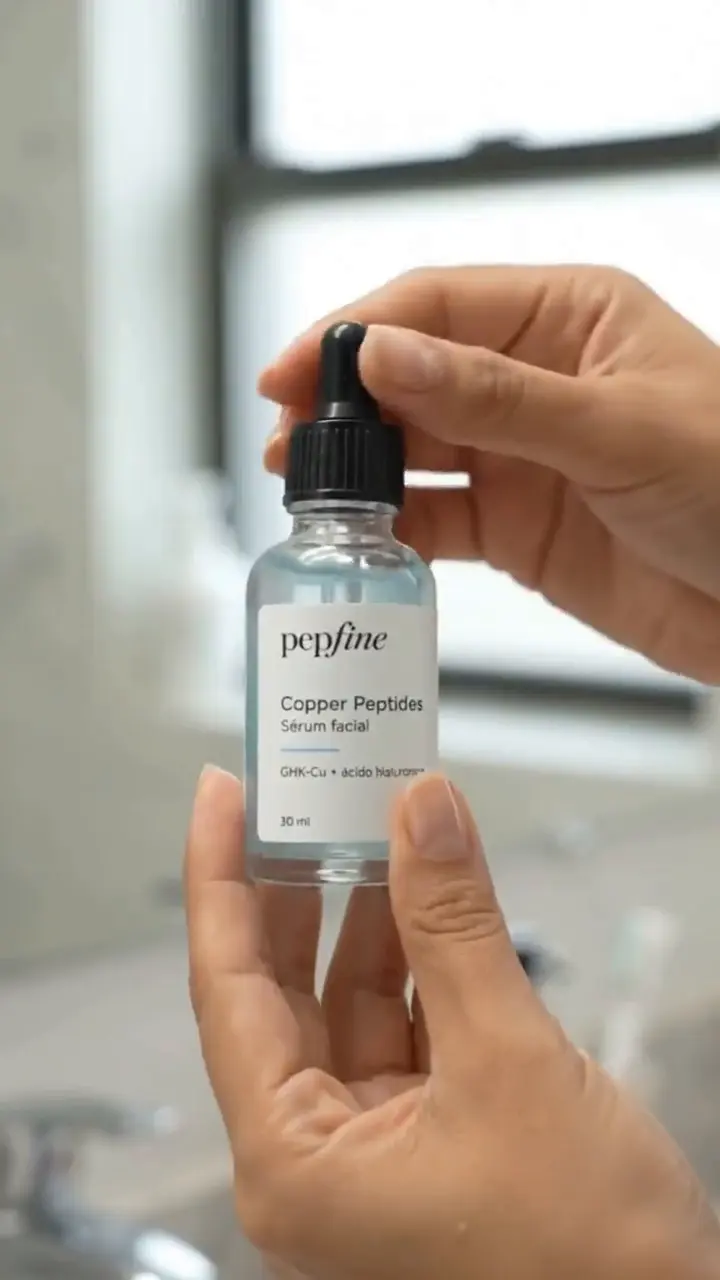
Pepfine es un sérum que junta el péptido de cobre con ácido hialurónico, que ayuda a que la piel retenga humedad y se sienta hidratada. Sí, se llama “ácido”, pero no exfolia: es un hidratante. No lleva ácidos exfoliantes y no tienes que aguantar purga.
In the morning: wash your face, apply 3 or 4 drops to face and neck, wait a minute and apply sunscreen. Put on makeup if you like. It takes less than two minutes.
At night: clean face and another 3 or 4 drops. No alternating acid nights with rest nights.
All we ask is a photo in the same light on days 1, 20, 40, 60 and 90. Skin changes slowly, and in the everyday mirror it's hard to notice. In photos, it isn't.
En el frasco vas a leer “Copper Peptides”: es el nombre del ingrediente en inglés.
The questions you surely have
«My skin is very sensitive.» It has no exfoliating acids. Even so, patch test it for 24 hours on your forearm. If it burns or stings, stop using it.
«I've already spent a lot on things that didn't work.» That's why there's a guarantee: if it doesn't work for you in 90 days, we refund your money.
«Why 90 days?» Because marks don't change overnight. In 90 days you get to see the change in your photos, not just in the mirror.
«Can I use it with makeup?» Yes. Let it absorb, apply sunscreen and then your makeup.
«I already use retinol or acids. Do I have to stop?» We won't ask you to throw anything away. If your skin is red and sensitive, try pausing exfoliation while you use Pepfine. If you have questions, write to us or ask your dermatologist.
«What if I don't have time?» It's 3 or 4 drops, twice a day. If you have time to wash your face, you have time for this.
«Can I pay at OXXO?» Yes. Also with Mercado Pago.
«Which sunscreen should I use?» A broad-spectrum one, SPF 30 or higher. Reapply if you're in the sun, even when it's cloudy.
If you want to try it
Your marks don't need more exfoliation. They need your skin to stop being irritated.
Pepfine is a cosmetic for external use. It is not a medicine. Results vary from person to person. If you have active breakouts or your skin gets very irritated, see a dermatologist.